


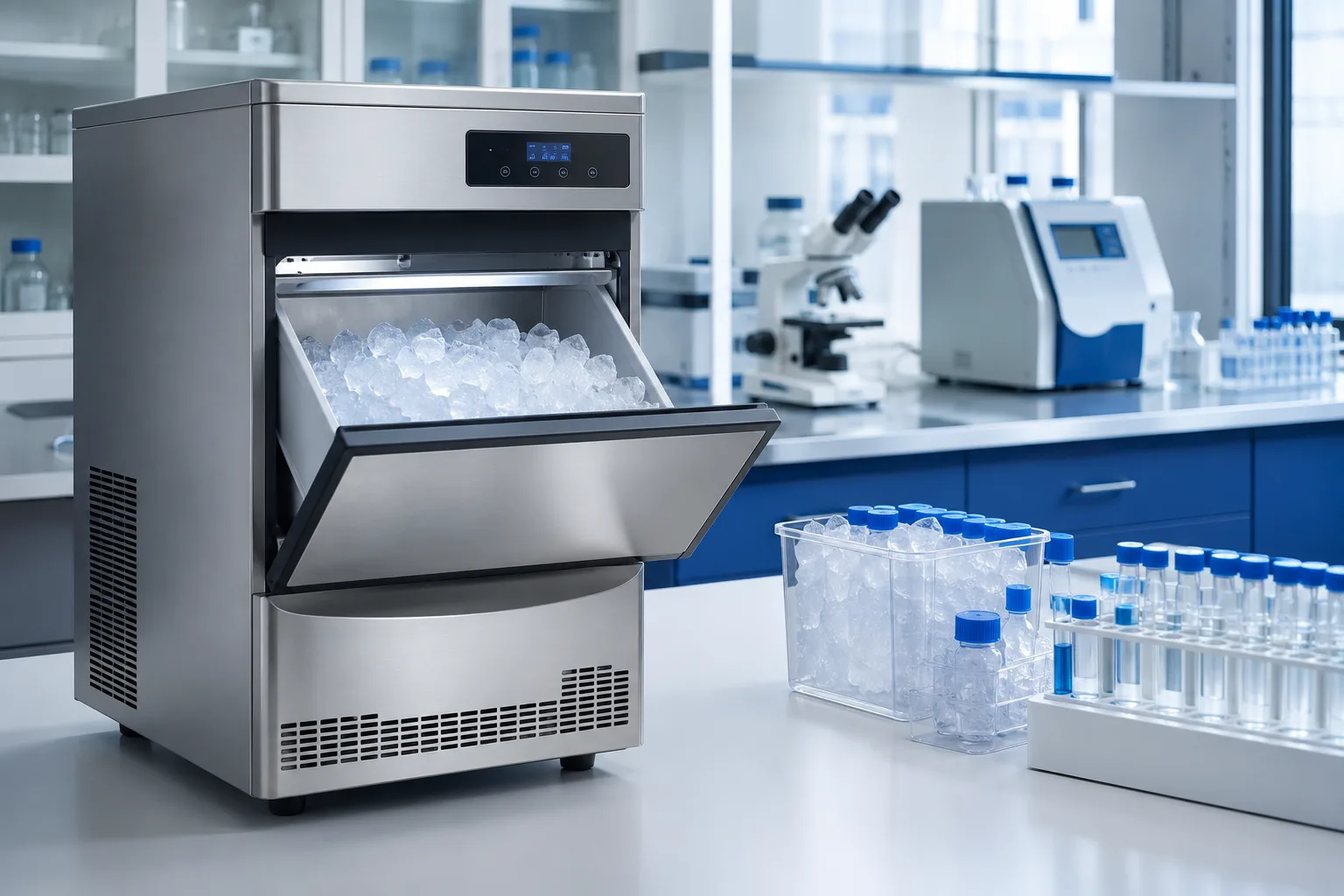
A standard cube ice machine is built for drinks service, not for handling vials, blood bags or temperature-sensitive reagents. Laboratories, pathology services and pharmaceutical facilities need a different type of ice altogether, and choosing the wrong machine can affect sample integrity rather than just convenience. This guide explains why granular ice is used in laboratory settings, where it is applied, and what to check before selecting a machine for a facility.
Why Granular Ice Is Used in Laboratories
Granular ice, sometimes called flake ice, behaves differently to standard cube ice in three ways that matter for laboratory work.
- Superior surface contact. Granular ice conforms to irregular surfaces such as vials, test tubes, blood bags and surgical trays, giving uniform cooling around an object’s actual shape rather than just the points where a hard cube happens to touch it.
- Reduced risk of damage. Granular ice is soft and non-abrasive, which lowers the risk of damaging fragile materials or labware compared with hard cube ice.
- Consistent cooling. Granular ice spreads thermal coverage evenly, reducing the hot spots or sudden temperature drops that can affect experimental repeatability and sample consistency.
Where Laboratory Ice Machines Are Used
Across research labs, hospitals, universities and pharmaceutical manufacturers, granular ice machines support a range of day-to-day tasks:
- Cooling biological samples, including blood, tissue, RNA or cell lines, during transport or active experimentation.
- Stabilising equipment, such as centrifuges, rotary evaporators and chromatography systems, which can overheat without adequate cooling.
- Creating ice baths, used for reaction control, chemical mixing and temperature-sensitive assays.
- Transporting temperature-sensitive materials such as vaccines, organ samples and reagents.
- Supporting cryotherapy, where precision cooling affects patient outcomes directly.
What to Look for in a Laboratory Ice Machine
Reliability and hygiene matter more in a laboratory setting than in most commercial kitchens, since a delayed result or a contaminated sample carries a higher cost than a slow drink order. The EG Series from Online Ice Machines is built around four requirements specific to this environment:
- Reliability for continuous operation, so there is no delay in environments where waiting is not an option.
- Hygienic design, with stainless steel and easy-to-sanitise surfaces that support safe handling and reduce contamination risk. Some models are suitable as GMP-compliant ice machines for pharmaceutical settings.
- Durability under sustained, high-volume use in demanding lab environments.
- Consistent granular ice quality, supporting precision cooling across storage and active experiments alike.
EG Series Specifications
Three EG Series models are commonly used in biomedical and laboratory settings:
- EG 100/15 – produces 100 kg of ice per day, with a 15 kg storage bin and power consumption of 700W.
- EG 140/25 – produces 140 kg of ice per day, with a 25 kg storage bin and power consumption of 700W.
- EG 140/60 – produces 140 kg of ice per day, with a 60 kg storage bin and power consumption of 700W.
All three are self-contained units, built in full stainless steel, and designed for continuous electro mechanical operation.
Matching Capacity to Your Lab’s Workload
Choosing between these models comes down to how much ice a facility uses day to day and how much it needs held in reserve. A smaller pathology lab handling routine sample storage may only need the EG 100/15. A larger facility running multiple experiments or supporting hospital-wide sample transport may need the higher storage capacity of the EG 140/60.
Online Ice Machines works directly with labs, hospitals, universities and pharmaceutical manufacturers to match production capacity to workload, choose between compact and high-output machines, confirm compliance with healthcare standards, and plan for future growth in demand.
Frequently Asked Questions
Q. What is a biomedical ice machine and how is it different from a standard commercial unit?
Ans: A biomedical ice machine prioritises hygiene, precision and consistent temperature control, and is built to comply with stricter sanitary standards than a general-purpose unit. It produces soft, uniform granular or flake ice that is safe for direct contact with samples.
Q. Why do laboratories need a specialised ice machine rather than a standard one?
Ans: A laboratory ice machine supports specific functions such as stabilising reagents, cooling test tubes and centrifuges, and creating controlled ice baths. These tasks need consistent, reliable output to keep temperature-sensitive experiments accurate and reproducible.
Q. What makes a medical ice machine suitable for healthcare settings?
Ans: A medical ice machine is built for hygiene, reliability and ease of cleaning, often with enclosed dispensing systems and antimicrobial materials, making it suitable for patient care areas, surgical rooms and diagnostic labs.
Q. Can an ice machine be used for sample storage and transport?
Ans: Yes. A dedicated granular ice machine provides the clean, uniform ice needed to preserve biological materials such as blood, tissue and DNA, with the surface contact required for stable temperatures during on-site storage or off-site transport.