


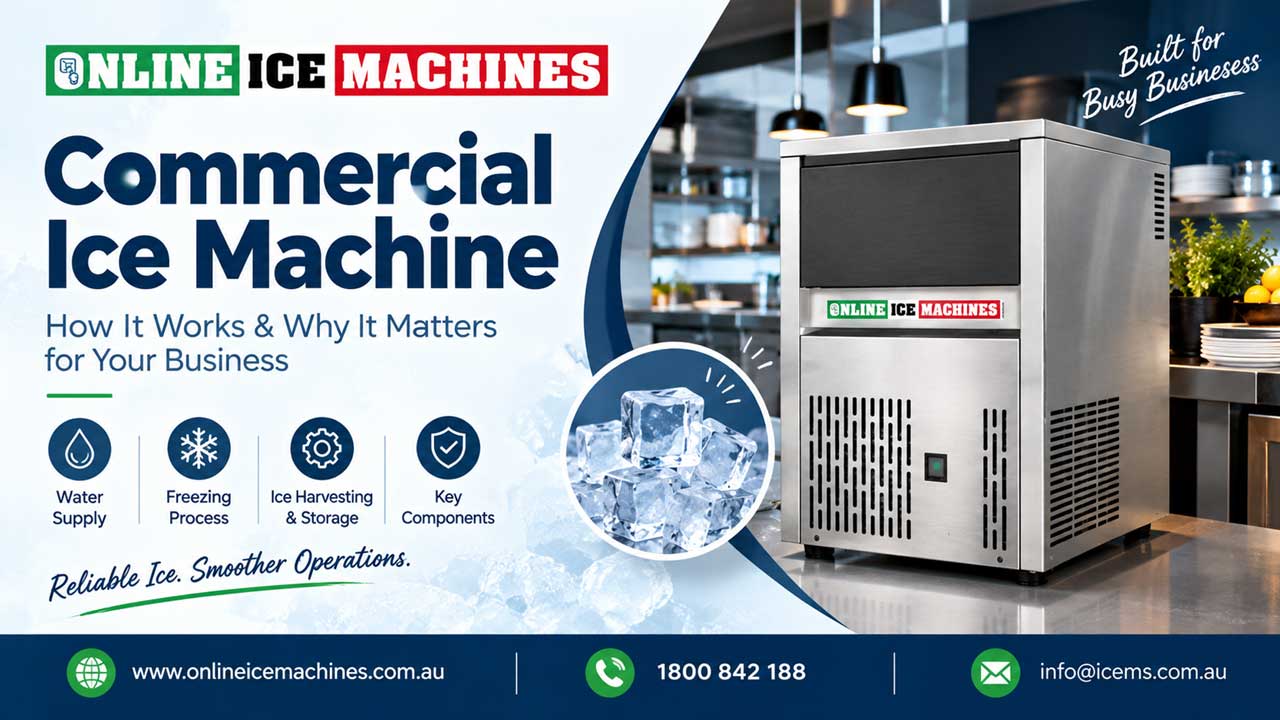
Do you know how does a commercial ice machine work? It takes water & removes heat from it. This uses a refrigeration system. The machine freezes it into a specific shape. Then it releases the ice into a storage bin. Behind this simple result are several components. Plus, there are carefully regulated stages working together.
Understanding the commercial ice machine working process is a must for restaurant owners. This is also beneficial for café operators, bars, hotels, supermarkets, etc. They can select the right equipment. Also, they can recognize when production issues need attention.
What Is a Commercial Ice Machine?
A commercial ice machine is modern equipment. It produces ice continuously. Or the process may take place in repeated cycles. Such a machine is a great option for companies requiring a reliable supply. Such a commercial unit is not like a small domestic ice maker. Bigger profitable models are built for higher production volumes. These support longer operating periods.
Online Ice Machines offers different configurations. We sell self-contained cube makers. We also deal in modular cube machines & granular/flake ice machines. Some self-contained models combine ice production & storage in one cabinet. But modular machines are used with a separate storage bin.
The exact process varies by machine design. But most units depend on 3 things-
- Water supply
- Refrigeration system
- The process for forming & harvesting ice
The refrigeration system typically includes a compressor & condenser. It also comprises an expansion device & evaporator. Together, these components remove heat from the water. The water gradually freezes.
Commercial Ice Maker Process: How Does a Commercial Ice Machine Make Ice
So, how does a commercial ice maker work from beginning to end? Individual models differ. But the generic method revolves around these stages.
1. Water Supply
The process starts when potable water enters the machine. This happens through the water inlet. According to the build of the unit, water is directed into a reservoir. It can also get to a trough or another part of the ice-making system. A water inlet valve controls how much water can pass through. The machine works on a decent water supply. Low pressure, blocked inlet components, or other issues ruin ice generation.
2. Filtration
Water quality has a major effect on an ice machine. Filtration reduces unwanted particles. This manages minerals contributing to scale. This is vital as mineral deposits can build up on components. These stop water flow. Such issues ruin ice quality & machine performance. The exact filtration requirement hinges on the device. Also, the water quality & factory recommendations are critical factors.
3. Refrigeration
This part makes the process possible. The compressor circulates refrigerant through the refrigeration system. The condenser releases heat. Meanwhile, the expansion device decreases refrigerant pressure. This takes place before it reaches the evaporator. At the evaporator, the cold refrigerant absorbs heat. This heat comes from the water or ice-making surface. In other words, the machine does not create cold water. It removes heat from the water. The process goes on until freezing begins.
4. Ice Formation
Water comes into contact with the cold evaporator surface. In many cube machines, water flows repeatedly across the evaporator. In the meantime, heat is removed. Ice gradually forms & reaches the ideal thickness. This controlled freezing process creates steady cubes. The precise formation method hinges on the machine’s design.
5. Harvesting
Firstly, a good amount of ice needs to form. Then, the machine shifts from the freezing phase. It enters the harvest stage. Many commercial cube machines use a hot-gas system. This makes the evaporator slightly warm. This loosens the ice from the evaporator. Then, it falls into the storage bin. Excess water may also be removed during this step.
6. Storage
The harvested ice falls into a storage bin. Self-contained machines have an integrated storage area. On the other hand, modular machines are set up with distinct ice storage bins. Online Ice Machines offers storage bins. These work with well-suited modular ice machine heads.
Eventually, the storage area will be full. Then, a sensor, curtain, thermostat, etc signals the machine to discontinue ice making.
How Does a Commercial Cube Ice Machine Work?
A cube ice machine follows the basic freeze-&-harvest cycle.
Water is circulated across a cold evaporator. Or it can also run into cube-forming areas. As heat is removed, the water freezes into individual cubes. Or ice can be formed in the shape of a connected sheet. This is then released.
During harvest, the machine warms the evaporator to get rid of the ice. The cubes then fall into the storage space.
Online Ice Machines’ self-contained cube machines include various models. These can produce 24 kg to 100 kg of ice per day. Meanwhile, its modular cube heads are available for higher production.
This makes cube machines right for the tasks mentioned below:
- Restaurants
- Cafés
- Bars
- Hotels
- Clubs
- Events
- Hospitality venues
The specific cube size & production capacity should be apt. It must match the company’s daily & peak demand.
How Does a Flake Ice Machine Work?
A flake ice machine works differently from an old-school one.
A flake machine creates soft, granular ice. It doesn’t make individual solid cubes. Online Ice Machines’ flake machines produce granular ice. This is already crushed & fine for seafood displays, food processing, & supermarkets. Plus, hospitals, bakeries, laboratories, & beverage firms can also benefit from such a unit.
The ice-making surface is cooled. Meanwhile, water is introduced to the freezing area. Ice starts forming. Then, it is removed continuously or progressively. So, small flakes/granules are seen.
Flake ice has a large surface area. This can conform closely to products. Such ice is useful where rapid cooling & product coverage are top priorities.
How Does a Modular Ice Machine Work?
A modular unit separates ice making from ice storage.
The ice-making head sits above a compatible storage bin. The head produces ice. On the other hand, the bin holds the finished product. It is removed over time.
This configuration is useful for businesses. They have higher production requirements or need extra storage flexibility.
Online Ice Machines deals in modular cube systems. These use vertical evaporator technology. These are designed for high-volume use. Our modular range is comprised of machines making 150 à 400 kg of ice each day. But the generation hinges on the particular device.
The main advantage is upgradability. Businesses should carefully select an ice-making head and storage capacity. This way, the machine will better suit their requirements.
What Factors Affect Ice Production?
Understanding how commercial ice machines work is critical. This way, companies will have an idea regarding why production can alter from 1 area or day to another.
Ambient Temperature
Air temperature can affect refrigeration performance. This is mainly the case with air-cooled machines. No machine should operate in a hot & poorly ventilated area. It may not produce ice at the same rate as it would under ideal circumstances.
Water Temperature
Warmer incoming water needs more heat to be detached. Then, freezing starts. This increases the freeze time & cut ice generation.
Water Quality
Hard water & mineral deposits can affect internal components. These also impact water flow & ice quality. Appropriate filtration & cleaning help manage such problems.
Machine Capacity
Every commercial ice machine has a rated production capacity. Choosing a machine that is too small is never an option for peak demand. This will surely leave a business short of ice.
Ventilation
Air-cooled machines demand good airflow. Restricted airflow will make the system work harder. This may cut the manufacturing of ice.
Maintenance
Always keep an eye on dirty parts or scale buildup. See if there are clogged filters, blocked water passages, etc. Such issues interfere with the ice maker process.
How Often Does a Commercial Ice Machine Make Ice?
A commercial machine doesn’t only make 1 large batch of ice in 1 day. It repeatedly moves through freeze & harvest cycles. But the storage bin can’t be 100% full.
The exact cycle duration varies. This depends on the machine, ice type, & cube thickness. Plus, ambient conditions & water temperature are crucial factors in this case. Some commercial cube machines can complete cycles in roughly 20 minutes. But people can see this under suitable operating conditions. Still, you must not treat this number as a universal figure.
The manufacturer rates the production in kilograms per day. This is generally more helpful when comparing machines.
What Happens When the Ice Bin Is Full?
Commercial ice machines know when the storage area gets full.
An ice curtain, bin switch, thermostat, infrared sensor, etc detects the full-bin condition. But this is variable according to the machine type. The unit then stops ice production.
Then, ice is removed & the storage level drops. And the control system allows production to continue. So, the machine won’t make ice when there is 0 space available.
How Maintenance Affects How Do Ice Machines Work?
Maintenance is an important topic for understanding how an ice machine makes ice.
Regular cleaning prevents mineral scale. It also stops other buildup from interfering with water flow & ice generation. Filters should also be checked. They must be replaced according to the factory recommendations.
Operators must pay heed to-
- Water flow
- Ice shape & consistency
- Bad noises
- Longer-than-normal freeze cycles
- Less daily production
- Extreme scale
- Condenser condition
- Drainage
- Ice quality & smell
A sudden change in production can be an early indication. This means that the machine needs cleaning. It also indicates that the unit may require fine-tuning or an expert’s attention.
When Should a Commercial Ice Machine Be Serviced?
There is no single service interval. So, this can’t apply to every machine. The correct schedule depends on the model & operating environment. Also, it hinges on the water quality, usage, & factory recommendations.
Still, professional service can be very crucial. So, do you see?
- Less ice production
- Longer freeze/harvest cycles
- Wrong ice size
- Water leaking around the machine
- Weird sounds
- Recurring mistake indicators
- Too much mineral buildup
- Bad ice quality
- Drainage issues
Regular maintenance is the best choice these days. People should never wait until the machine stops making ice.
Some businesses depend on ice every day. Preventative attention will help them reduce surprising interruptions during busy periods.
How to Select the Right Commercial Ice Machine for Your Business?
Knowing how does a commercial ice machine work is vital. You can understand why machine type, capacity, & water quality are so important. You can also get a clear idea about ventilation, drainage, & maintenance.
Does your business need cube ice for drinks? Does it need granular ice for food displays? Or does it demand a high-output modular system? In any case, selecting equipment matching your application is important.
Online Ice Machines offers commercial ice-making solutions. These help hospitality, food service, industrial, etc across Australia. We sell self-contained cube makers & modular cube machines. Plus, we also deal in flake machines & compatible storage bins.
Contact us today! Discuss your ice requirements & buy the right commercial ice machine for your business. Also follow us on – Facebook, Instagram and YouTube for more update. Hope you understand how does a commercial ice machine work.
FAQs:
Q. Do commercial ice machines need a drain?
Ans: Yes, most commercial ice machines need a drain. This can remove excess water, meltwater, & water produced during cleaning or the ice-making cycle. The exact drainage setup depends on the machine. Gravity drains & pump-assisted drainage are common options. Always check the set up requirements coming from the factory.
Q. Do commercial ice machines keep ice frozen?
Ans: Commercial ice machine bins are generally insulated. These slow melting. But they do not actively freeze stored ice like a freezer. Some melting is normal. The resulting water is usually moved toward the drain. For this reason, ice should be used. It must be replenished regularly. It can’t be stored for an indefinite period.
Q. How long does it take a commercial ice machine to make ice?
Ans: The cycle time varies by machine type & ice size. Plus, water temperature, surrounding temperature, etc matter a lot. Many commercial cube machines can produce a batch in roughly 10–20 minutes. But other models may take longer. The machine’s stated production rate is the best guide for a certain unit.
Q. How much ice can a commercial ice machine produce per day?
Ans: Production varies significantly by model & capacity. Smaller commercial machines may produce around 20 to 100 kilos of ice each day. Meanwhile, larger modular machines can produce much more than this range in 24 hours. Actual output can be affected by ambient temperature. This can also be influenced by water temperature, ventilation, & upkeep.