


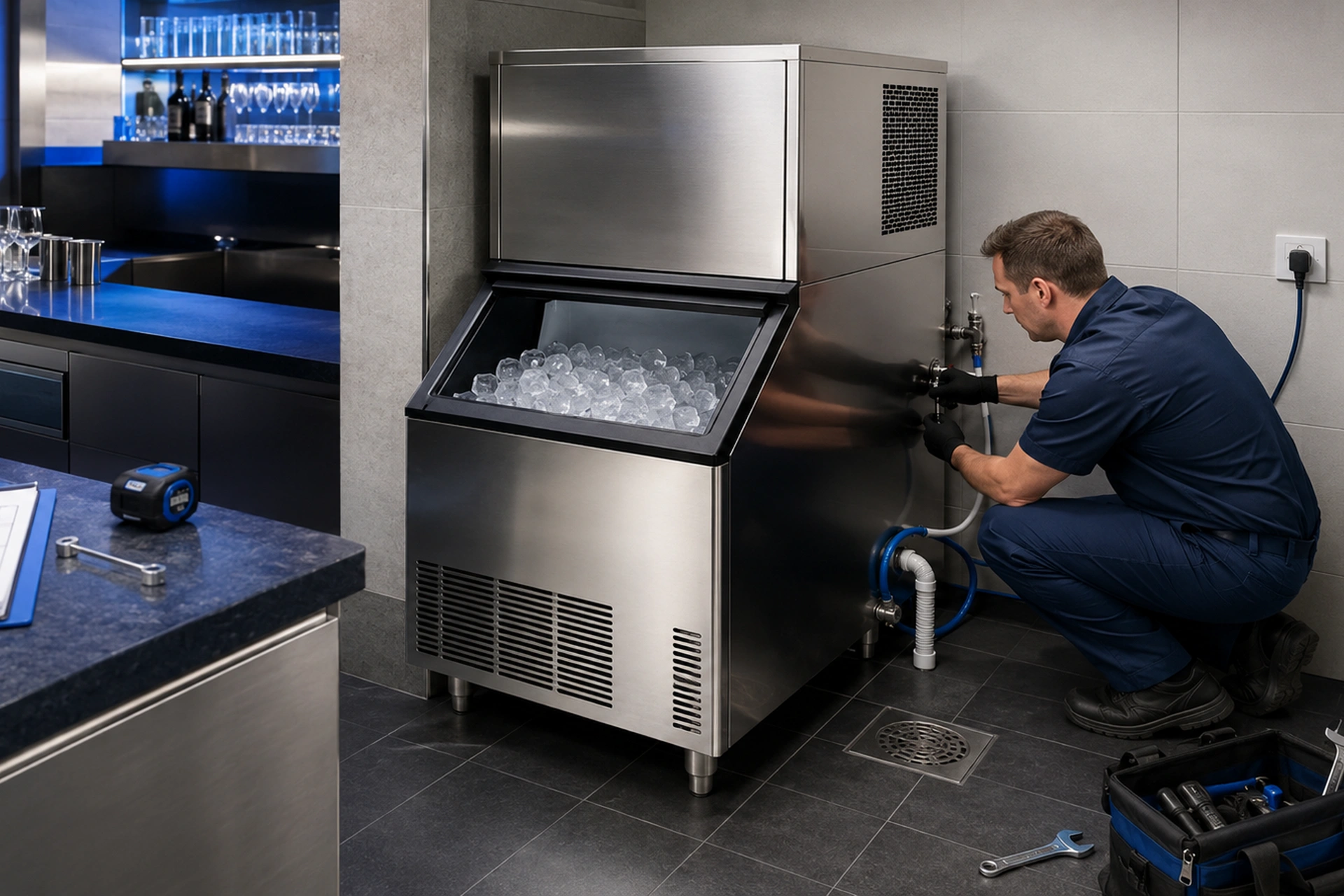
Buying the right commercial ice machine is only half the job. Where and how it gets installed has a direct effect on how much ice it produces, how long it lasts and whether it meets the electrical and plumbing codes that apply in Australia. This guide sets out the actual site requirements for installing a commercial ice machine, the mistakes that most often cause problems, and what determines installation cost.
Space and Dimensions Come First
Before a machine arrives, the site needs to be measured properly. Commercial ice machines come as either self-contained units or as a separate head and bin combination. Both the machine and, where relevant, the bin need to physically fit not only in the space where they will sit, but through every doorway and hallway between the delivery point and that space.
This sounds obvious, but it is one of the most common reasons an installation is delayed. A modular head and bin that fit comfortably side by side in a kitchen plan can still fail to clear a narrow service corridor if the corridor width was not checked beforehand.
Location Requirements
Where the machine is placed inside the building affects how well it performs, not just whether it fits.
- The ambient temperature in the location should stay between 10 and 35 degrees Celsius. Outside this range, ice production is affected.
- The machine should not be installed inside a cool room or in any environment that chills the surrounding air, because this slows ice production rather than helping it.
- It should not be installed inside a cupboard or any other enclosed space.
- Once installed, the machine needs adequate clearance around it for ventilation and for future servicing.
These requirements exist because an ice machine relies on drawing in ambient air to run its refrigeration cycle. Restrict that airflow, or place the machine somewhere with an unusual ambient temperature, and output drops even though the machine itself is working correctly.
Power and Water Requirements
Every commercial ice machine needs an electrical connection, a water supply and a drainage point, and Online Ice Machines sets out the following requirements for all machines in its range:
- Electrical, drainage and water connections should be within 1.2 metres of the machine.
- These connections need to meet local, state and national codes, and should be installed by qualified persons.
- A separate fuse or circuit breaker should be provided for the ice machine where necessary.
- Water pressure needs to sit between 0.1 MPa and 0.6 MPa for the machine to operate correctly.
- A suitable water filter should be fitted where required. A water filter assembly can be sourced and fitted as part of the installation.
Common Installation Mistakes
Most installation problems trace back to one of the requirements above being skipped or assumed rather than checked. The most frequent mistakes are:
- Installing in an enclosed space. A machine placed inside a cupboard or tight alcove without airflow will run hotter and produce less ice than the same machine in an open, ventilated location.
- Placing the machine in or near a cool room. This seems logical on the surface, since the area is already cold, but a cool room environment actively slows ice production rather than assisting it.
- Underestimating the distance to power, water and drainage. Connections need to be within 1.2 metres of the unit. Sites are sometimes planned around where there is convenient floor space rather than where existing services are located.
- Skipping the water filter. Water quality varies by location, and an unfiltered supply can lead to scale buildup that affects ice quality and shortens the life of internal components.
- Using unqualified trades for electrical or plumbing work. These connections need to meet local, state and national codes. Using anyone other than a qualified, licensed tradesperson risks both a non-compliant installation and a potential warranty issue.
Should You Install It Yourself or Use a Professional?
Some parts of installation, such as final positioning and connecting hoses that are designed for general use, can be managed without a tradesperson. However, the electrical, drainage and water connections need to be made by qualified persons and meet relevant codes, which generally means a licensed electrician and plumber need to be involved at some stage of the process.
Online Ice Machines provides a generic set of installation instructions with every machine purchased, since the exact requirements vary depending on the type of machine, its power draw and its dimensions. Businesses unsure about any part of the process are encouraged to get in touch before installation day, rather than after a problem appears.
What Installation Costs Depend On
Installation cost is not a fixed figure, because it depends on the condition of the site rather than the machine alone. The main factors that affect cost are:
- How far existing power, water and drainage points are from where the machine will sit.
- Whether a new dedicated circuit or fuse is required.
- Whether a water filter assembly needs to be added to the supply line.
- Whether the building’s existing plumbing and electrical work already meets the relevant codes, or needs upgrading first.
Because of this, businesses planning an installation should get a site-specific quote from a licensed tradesperson rather than assuming a standard cost across every property.
Frequently Asked Questions
Q. What temperature range does an ice machine need to operate in?
Ans: The ambient temperature around the machine should stay between 10 and 35 degrees Celsius. Outside this range, ice production is affected.
Q. Can an ice machine be installed in a cool room?
Ans: No. Installing a commercial ice machine inside a cool room, or any environment that chills the surrounding air, slows ice production rather than helping it.
Q. How close do power and water connections need to be to the machine?
Ans:Electrical, drainage and water connections should be within 1.2 metres of the ice machine, and need to be installed by qualified persons in line with local, state and national codes.
Q. Does every installation need a water filter?
Ans: A water filter should be fitted where required, based on local water quality. Online Ice Machines can assist with a water filter assembly as part of the installation.