


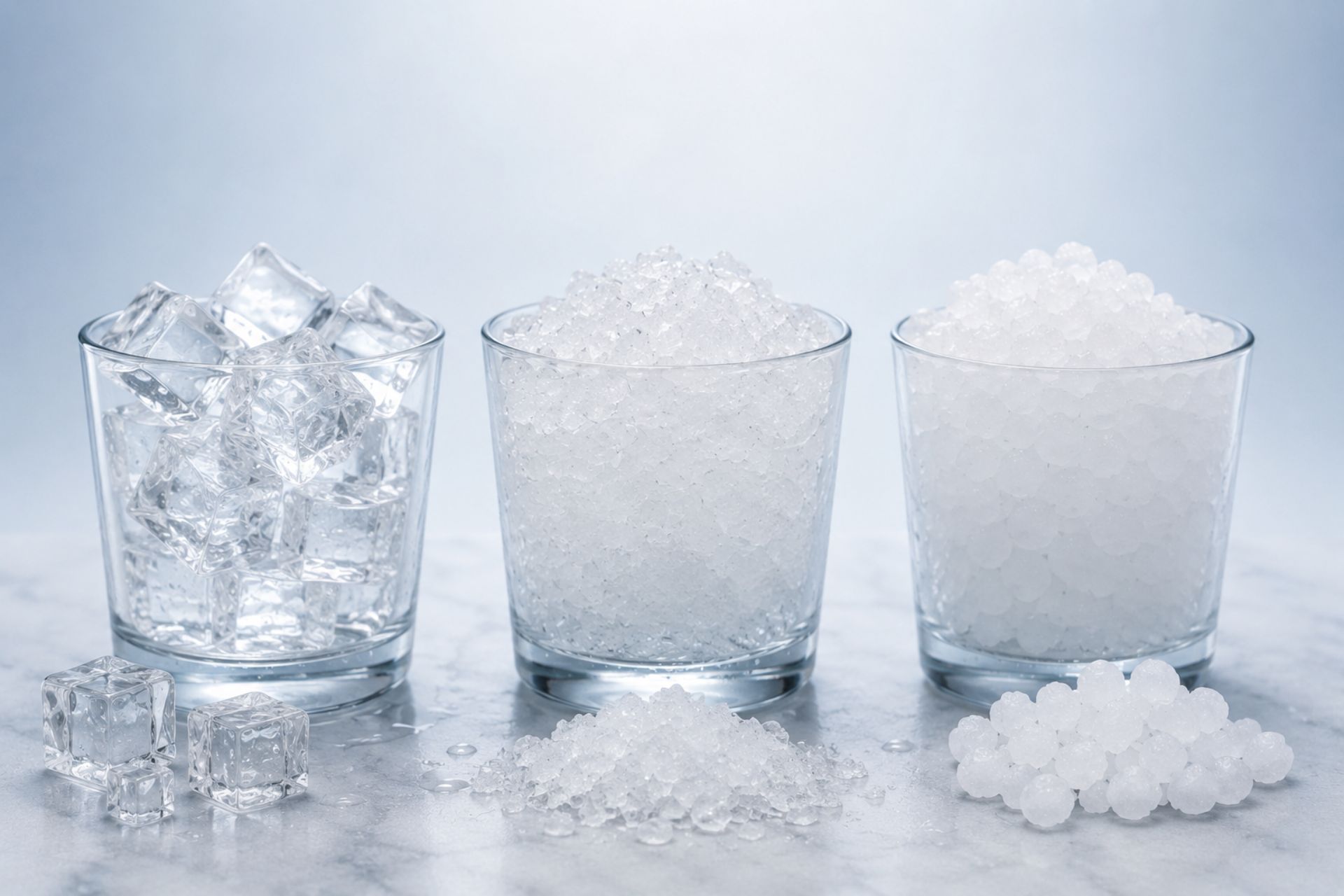
Choosing the Right Ice Type for Your Business
Buying the wrong ice machine for your application is more common than it should be. A bar owner ends up with a flake machine because it was on sale. A seafood retailer buys a cube machine because it was what the rep had in stock. The result in both cases is the same: a machine that technically works but produces ice that does not suit the use.
The three most common commercial ice types, cube, flake, and nugget, each have specific properties that make them well-suited to some applications and poorly suited to others.
Cube ice
Ice cube makers produce cube ice in full-cube formats of approximately 37g per cube and half-cube formats of approximately 15g. This ice type is widely used for beverage service in bars, restaurants and hotels. Full cubes melt slowly due to their low surface-area-to-volume ratio, which keeps drinks cold without diluting them quickly. This is why premium cocktail bars and spirit-focused venues almost always use full cube or gourmet conical ice.
Half cubes pack more tightly into glasses, produce slightly faster chilling, and suit high-volume soft drink and iced coffee service. Most commercial undercounter and modular machines sold in Australia produce half cubes by default.
Cube ice works well for: bars, restaurants, cafes, hotel beverage service, and convenience stores.
It is not suitable for: seafood display, food preservation, healthcare, or any application requiring ice to conform around a product or body part.
Flake ice
Flake ice is soft, irregular, and has a very high surface area relative to its mass. This makes it highly effective at surrounding and cooling irregular shapes, whether that is a fillet of salmon on a display tray or a patient’s knee. It moulds around whatever it contacts, providing even, consistent temperature reduction without bruising or damage.
The tradeoff is melt rate. Because flake ice has a large surface area, it melts faster than cube ice when exposed to warm air. A well-insulated storage bin and a consistent supply are both important. Flake machines paired with Online Ice Machines’ ice storage bin hire give businesses the storage buffer they need during high-demand periods.
Flake ice works well for: seafood retailers, fishmongers, food processors, supermarket display counters, healthcare and cold therapy applications, and mining sites where large-area cooling is needed.
It is not suitable for: beverage service where slow melt and presentation matter.
Nugget ice
Nugget ice, also called chewable ice or pellet ice, is compressed flake ice formed into small cylindrical pieces. It is softer than cube ice, chewable, and absorbs the flavour of the drink it is in. These properties make it extremely popular in fast food and healthcare settings.
In hospital and aged care environments, nugget ice is the preferred format for patients with swallowing difficulties because it softens quickly in the mouth. It is also the ice type behind the loyal customer base that drove the growth of brands like Sonic Drive-In in the US, where the ice itself became a selling point.
In Australia, nugget ice machines are less widely stocked than cube and flake machines, but demand in the healthcare and quick service restaurant sectors has been growing. Hoshizaki and Follett both supply nugget-capable units to the Australian market.
Nugget ice works well for: fast food, hospitals, aged care, sports medicine, soft drink-heavy venues.
It is not well-suited to: spirits, cocktails, or any application where slow melt and ice clarity are priorities.
A quick comparison
- Cube: slow melt, clear, professional presentation. Best for bars and restaurants.
- Flake: fast cooling, moulds to shape, higher melt rate. Best for food display and healthcare.
- Nugget: chewable, flavour-absorbing, softer. Best for healthcare and fast food.
FAQs
Can one machine produce both cube and flake ice?
No. Cube and flake machines use fundamentally different evaporator designs. A business that needs both types, such as a hotel with both bar service and a seafood buffet, requires two machines.
Is flake ice food-safe for direct consumption?
Yes, provided the machine and bin are cleaned and maintained on schedule. The same food safety standards apply to flake ice as to cube ice.
Which ice type is most energy-efficient?
Flake ice machines generally use less energy per kilogram of ice produced than cube machines because the freezing process is simpler. However, the higher melt rate means you may need to produce more total volume over a day, which offsets some of the efficiency gain.
Where can I see these machines before buying?
Online Ice Machines offers commercial ice machine hire across Australia, which lets businesses trial a machine type and capacity before committing to a purchase.